Advertisement










Private equity has played a significant role in shaping Indi...
In today’s real estate landscape, fitness is often treated...
In this episode of Prop Personalities, we sit down with Hars...
Luxury real estate is one of the most talked-about segments ...
Welcome to Prop Personalities by Prop News Time - a podcast ...
Navi Mumbai Municipal Corporation (NMMC) has been included in the 'Super Swachh League' along with Indore and Surat in the Swachh Survekshan rankings. A 21-member study group from the Indian Institute of Management (IIM) Indore recently visited NMMC to understand wastewater management practices. The delegation explored key infrastructure, including the sewage treatment plants and recycled water usage. Additionally, a special meeting led by Municipal Commissioner Dr. Kailash Shinde was held with construction professionals, architects, and contractors to encourage the use of tertiary treated water for construction and industrial purposes. Experts highlighted the benefits of treated water in reducing dependency on drinking water, with industry representatives expressing their willingness to cooperate.
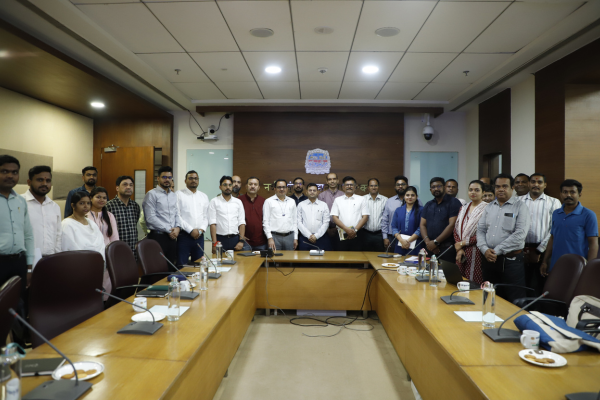
Navi Mumbai Municipal Corporation (NMMC) has won a spot in the elite 'Super Swachh League' under the Swachh Survekshan programme, along with Indore and Surat. NMMC has been maintaining its high standards of cleanliness all the while, drawing study groups from all over the nation eager to learn from its waste and water management systems. Advertisement


As a part of this continual knowledge sharing, a group of 21 delegates from the Indian Institute of Management (IIM) Indore came to visit NMMC to learn about post-consumption water management, i.e., wastewater treatment. The study team was greeted by Deputy Commissioner of Solid Waste Management, Mr. Santosh Warule, who welcomed Mr. Rahul Bhat, Deputy General Manager of the Academic Department of IIM Indore. During the tour, Mr. Warule gave a detailed presentation of NMMC's sanitation policies, solid waste management system, and sewage treatment. He also clarified various questions put forth by the group, which included environmental specialists from across the nation.
The delegation visited a number of important locations, such as NMMC headquarters, a nature park constructed on a previously used landfill area at Koparkhairane, a sanitation park, and an urban forest developed through the Miyawaki technique. They also visited the state-of-the-art sewage treatment plant at Koparkhairane, which uses Sequential Batch Reactor (SBR) technology, as well as its tertiary treatment plant that cleanses water in a three-stage process. The group saw how water is utilized from recycling, how aspirational toilets that produce water sustainably work from sewage, and how flap gates in holding ponds are handled for emergency scenarios. Most participants of the research group appreciated the contemporary and eco-friendly way that Navi Mumbai was planned as a city, praising both its technology and people's hospitality.
In another development, a special meeting was convened at NMMC headquarters by Municipal Commissioner Dr. Kailash Shinde. The agenda was to popularize the use of tertiary treated water in construction and industrial sectors to save potable water. A good number of construction professionals, architects, and contractors participated and assured complete support to the cause.
During the meeting, Sixth Director of Urban Planning, Mr. Somnath Kekan, highlighted that implementing tertiary treated water in construction and industrial projects would significantly reduce reliance on drinking water, reinforcing Navi Mumbai's position as a leader in sustainable urban planning. Additional City Engineer, Mr. Arvind Shinde, elaborated on NMMC's water supply system and the usage of treated water from state-of-the-art sewage treatment plants. NMMC has seven state-of-the-art sewage treatment plants today, which provide purified water to housing societies for garden and landscape watering. There are also 20 tertiary treatment plants in Koparkhairane and Airoli, with a capacity of 40 million litres per day each. The plants provide treated water to 55 industries located in the Maharashtra Industrial Development Corporation (MIDC) zone, with additional expansion on the anvil with industry partners. Apart from this, 11 Ready Mix Concrete (RMC) plants within the MIDC region get treated water for construction activities.
As huge redevelopment and construction work is going on in Navi Mumbai, water demand has increased. In light of decreasing annual rainfall and the risk of a shortage of drinking water, secondary and tertiary treated water adoption is the need of the hour. NMMC reacted with a circular issued earlier this week, directed by Dr. Kailash Shinde, encouraging stakeholders to accept the use of tertiary treated water. The move was well-received, with industry experts accepting their social obligation in water conservation.

5th Jun, 2025

25th May, 2023

11th May, 2023

27th Apr, 2023
Advertisement





 Facebook
 Whatsapp
