Advertisement










In this episode of Prop Personalities, we sit down with Hars...
Luxury real estate is one of the most talked-about segments ...
Welcome to Prop Personalities by Prop News Time - a podcast ...
Airports play a much bigger role than just enabling travel -...
Why does the same hotel brand operate multiple properties in...
The Maharashtra government has teamed up with the Asian Development Bank (ADB) to get INR 1,527 crore in finance for phase II of the Nagpur Metro project. Signed earlier this month, the deal aims to improve connectivity in Nagpur and the surrounding territories. The total funding for this phase is INR 3,586 crore, with contributions from ADB and the European Investment Bank. The project, which spans 43.8 kilometers across four routes, is intended to serve roughly one million citizens by promoting efficient transit and regional development.
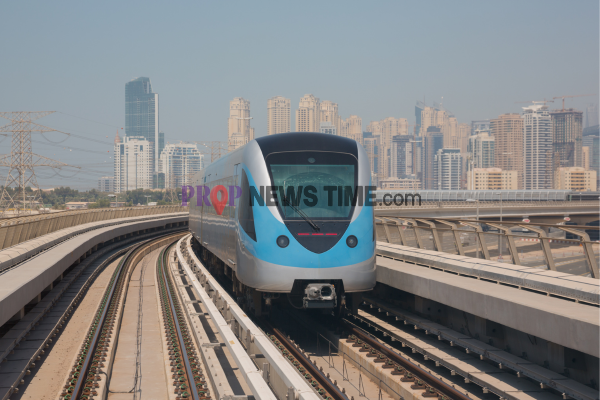
The Maharashtra government has made a big step toward improving urban mobility in Nagpur by signing an agreement with the Asian Development Bank (ADB) for INR 1,527 crore in financial support for phase II of the Nagpur Metro project. The memorandum of agreement (MoU) was signed earlier this week at the Vidhan Bhavan's cabinet hall by MahaMetro managing director Shravan Hardikar and ADB director Mio Oka, in the presence of Chief Minister Devendra Fadnavis. Advertisement


Chief Minister Fadnavis voiced confidence in the project, citing its potential to expedite Nagpur's development and increase connectivity throughout the city and its surroundings. He emphasized that the expansion is consistent with the state's aim of promoting sustainable urban transportation alternatives to meet increasing demand. The ADB and the European Investment Bank will jointly fund Phase II of the Nagpur Metro Rail project for a total of INR 3,586 crore. The ADB's part, INR 1,527 crore, will be paid in Japanese Yen, a move intended to capitalize on reduced interest rates. The money will be routed through the Union Ministry of Housing and Urban Affairs (MoHUA) to ensure efficient implementation.
This phase will add 43.8 km to the metro network, covering four new routes: 18.5 km from Khapri to MIDC ESR, 13 km from Automotive Square to Kanhan River, 5.6 km from Prajapati Nagar to Transport Nagar, and 6.7 km from Lokmanya Nagar to Hingna. The extension seeks to provide smooth transit alternatives to the city's periphery while also connecting industrial, residential, and commercial zones. Nagpur Metro's phase I, which opened in 2019, already covers 38 kilometers across two lines, providing contemporary and efficient transportation to thousands of commuters every day. With an investment of INR 8,680 crore, it established a benchmark in urban infrastructure and received backing from international financial institutions including ADB and Germany's KfW.
Building on the success of phase I, phase II aims to meet the growing need for efficient public transportation and integrate Nagpur's quickly expanding suburbs. This extension will help over one million residents by shortening commute times, reducing traffic congestion, and lowering pollution levels. Nagpur's strategic placement in India's geographical core, combined with its rise as a logistics and industrial hub, makes this development all the more important. Improved metro connectivity is intended to attract investment, create job opportunities, and boost regional economic growth.
This engagement with ADB demonstrates Maharashtra's commitment to leveraging international collaborations to deliver sustainable and cost-effective infrastructure projects. By developing the Nagpur Metro, the state hopes to create an example for other Indian cities by combining economic expansion with environmentally sustainable solutions.
The Maharashtra government's collaboration with ADB is a significant step in advancing the Nagpur Metro's phase II project. With substantial funding and aspirations for a massive 43.8 kilometer network, the program is poised to alter urban mobility for Nagpur's one million citizens. Beyond enhanced transportation, the project demonstrates the state's commitment to sustainable development and regional growth. The engagement with international financial institutions also demonstrates the state's emphasis on strategic funding at favorable terms to support large-scale infrastructure projects.

5th Jun, 2025

25th May, 2023

11th May, 2023

27th Apr, 2023
Advertisement





 Facebook
 Whatsapp
