Advertisement






What really powers the cloud? Behind every Google search, A...
A lot of what defines a home isn’t visible at handover. I...
Private equity has played a significant role in shaping Indi...
Luxury real estate is one of the most talked-about segments ...
Airports play a much bigger role than just enabling travel -...
Karjat is gradually transitioning from a weekend-home and leisure destination into a potential first-home residential market as infrastructure development, improving connectivity and expanding social infrastructure reshape buyer interest across the Mumbai Metropolitan Region. Industry stakeholders indicate that projects such as the Mumbai Trans Harbour Link, the upcoming Navi Mumbai International Airport, the proposed Virar-Alibaug Multimodal Corridor and the Panvel-Karjat suburban rail corridor are expected to significantly improve accessibility over the coming years. Compared to Mumbai and Navi Mumbai, Karjat continues to offer lower residential costs, larger living spaces and lower-density surroundings, attracting first-time buyers, hybrid-working professionals and families seeking long-term liveability. Developers and industry bodies believe the region could evolve into a major residential growth corridor within the next five years.
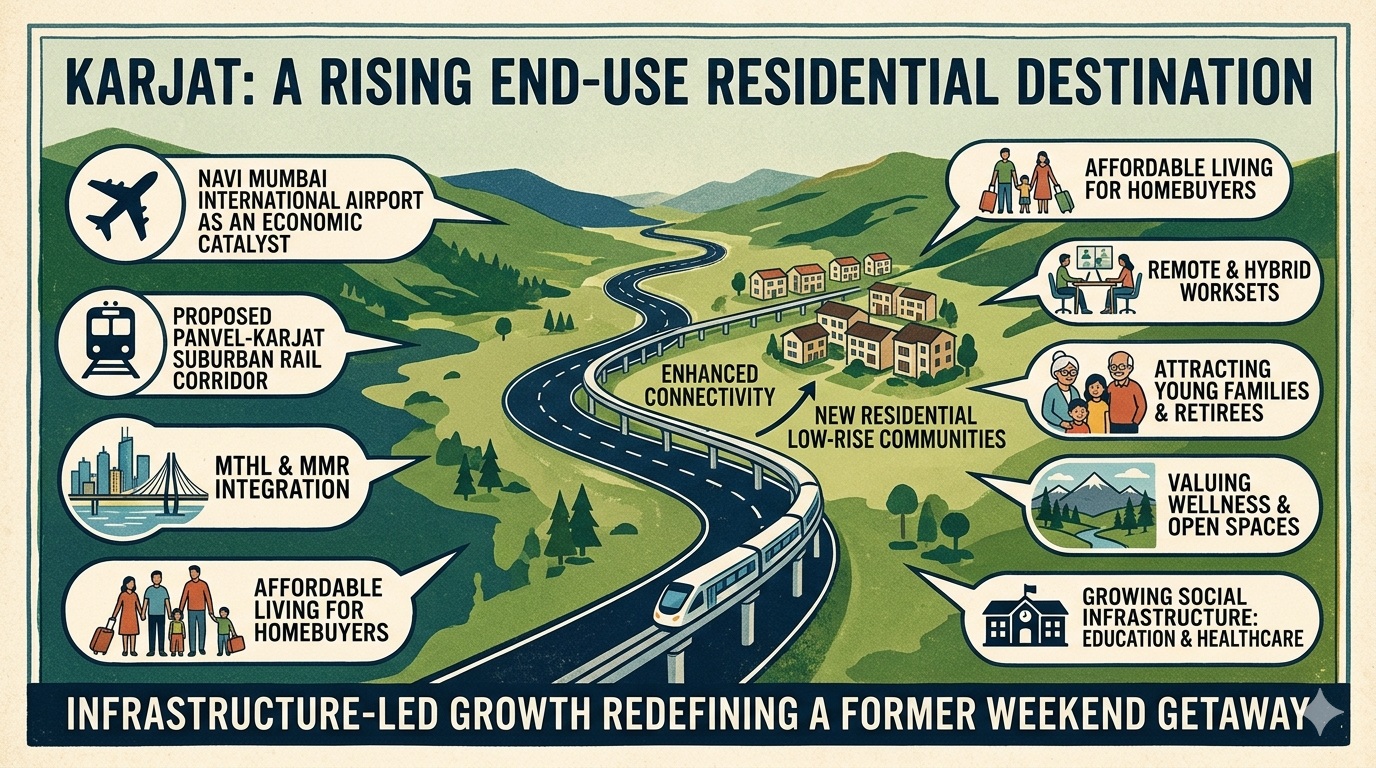
Karjat is increasingly emerging as a potential first-home residential destination within the Mumbai Metropolitan Region as large-scale infrastructure projects, improved regional connectivity and changing lifestyle preferences reshape buyer perception towards peripheral housing markets. Advertisement






For several years, the region was primarily associated with second homes, holiday properties and weekend retreats catering to Mumbai-based buyers seeking low-density living environments outside the city. However, industry stakeholders indicate that the market is now witnessing a gradual transition towards end-use residential demand.
Developers and consultants state that rising property prices across Mumbai and Navi Mumbai are prompting homebuyers to explore peripheral growth corridors offering comparatively affordable housing, larger residential spaces and stronger long-term liveability potential.
Karjat is increasingly attracting young families, first-time buyers, retirees and professionals working under hybrid employment models due to its lower-density environment, natural surroundings and comparatively lower acquisition costs.
A major factor driving this shift is the region’s improving connectivity infrastructure across the Mumbai Metropolitan Region.
Projects including the Mumbai Trans Harbour Link, the upcoming Navi Mumbai International Airport, the proposed Virar-Alibaug Multimodal Corridor, the JNPT-Chowk Highway and expanding regional road networks are expected to significantly improve travel efficiency and regional integration over the coming years.
In addition, the proposed Panvel-Karjat suburban rail corridor is expected to strengthen suburban rail connectivity and support large-scale residential growth across the Karjat belt.
Industry observers indicate that improved infrastructure is gradually changing how buyers perceive Karjat within the larger metropolitan framework. The location is increasingly being viewed not as a distant outskirts market but as an emerging extension of the Mumbai Metropolitan Region with improving accessibility to Navi Mumbai, Thane and parts of Mumbai.
According to developers, the region currently sits at an important stage where infrastructure-led development and planned urbanisation could significantly alter its residential positioning over the next five years.
Unnati Varma, Director at ORA Land by ORA Group, stated that Karjat is gradually transitioning from a second-home destination towards a location capable of supporting permanent residential communities.
She added that upcoming infrastructure corridors are expected to improve connectivity substantially, while changing buyer preferences towards wellness, affordability and open spaces are strengthening interest in peripheral residential destinations.
Varma further stated that continued improvements in transportation infrastructure, planned developments and social amenities are expected to enhance Karjat’s long-term liveability.
Gautam Thacker, Founder President and Chairman of NAREDCO Raigad, stated that the Navi Mumbai International Airport is expected to become a major economic catalyst for the wider Mumbai Metropolitan Region.
According to him, locations including Karjat, Neral, Panvel and Khalapur are likely to witness increasing residential and commercial relevance as airport-linked economic activity expands across the region.
Industry stakeholders further note that airport-led development typically drives associated commercial activity including logistics infrastructure, hospitality projects, educational institutions, commercial parks and entertainment zones, which in turn strengthen surrounding residential markets.
Alongside infrastructure growth, the Karjat region is also witnessing gradual expansion of social infrastructure including educational facilities, healthcare services, retail establishments and hospitality developments.
Developers state that this ecosystem expansion is critical in transforming the area from a seasonal occupancy market into a viable long-term residential destination capable of supporting permanent communities.
Another factor supporting demand is Karjat’s natural landscape comprising hills, rivers and green surroundings, which aligns with rising buyer preference for wellness-oriented and lower-density living environments following the pandemic.
Industry experts indicate that homebuyers are increasingly prioritising cleaner air, open spaces, reduced congestion and community-driven residential formats while evaluating long-term housing decisions.
As urban expansion across the Mumbai Metropolitan Region continues outward, infrastructure-linked peripheral markets are expected to play a larger role in shaping the next phase of residential development, with Karjat emerging among the closely watched growth corridors within the region.

5th Jun, 2025

25th May, 2023

11th May, 2023

27th Apr, 2023
Advertisement









 Facebook
 Whatsapp
