Advertisement






What really powers the cloud? Behind every Google search, A...
A lot of what defines a home isn’t visible at handover. I...
Private equity has played a significant role in shaping Indi...
Luxury real estate is one of the most talked-about segments ...
Airports play a much bigger role than just enabling travel -...
Growing infrastructure development, urban expansion and increasing regulatory transparency are driving renewed investor interest in land as a long-term wealth creation asset alongside traditional investments such as gold and equities. Industry stakeholders stated that organised plotted developments and improved accessibility to land ownership are attracting both first-time and experienced investors across emerging growth corridors. The discussion around asset allocation has also intensified following Prime Minister Narendra Modi’s recent remarks urging restraint in non-essential gold purchases to help conserve foreign exchange reserves. Real estate and financial sector participants noted that while gold continues to serve as a defensive asset and equities offer higher growth potential, land investments are increasingly being viewed as a relatively stable, inflation-resistant asset class supported by infrastructure-led urbanisation and rising demand in peripheral markets surrounding major cities and Tier II locations.
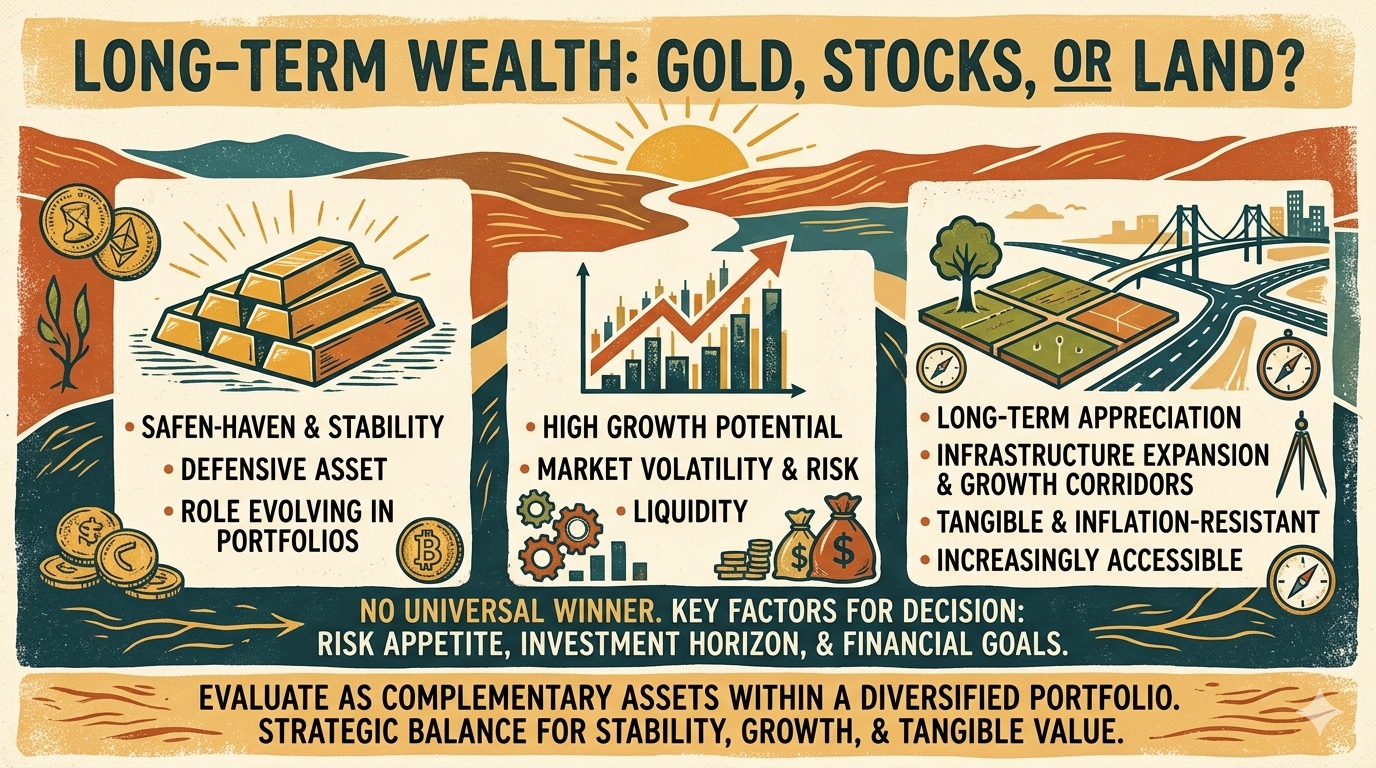
The comparison between gold, equities and land investments has gained renewed attention in India’s investment market as infrastructure expansion and urban development continue to reshape investor preferences across asset classes. Industry participants stated in the past week that land investments, particularly in emerging growth corridors and plotted developments, are witnessing increasing traction among investors evaluating long-term wealth creation opportunities. Advertisement






The discussion has gathered momentum following Prime Minister Narendra Modi’s recent appeal urging citizens to reduce non-essential gold purchases in an effort to help conserve India’s foreign exchange reserves. The remarks have triggered broader conversations within financial and real estate sectors regarding the role of gold in long-term portfolio allocation and the growing shift towards real estate-backed and equity-led investments.
According to market participants, gold has traditionally been viewed as a defensive investment during periods of economic uncertainty and inflationary pressure, while equities continue to attract investors seeking higher long-term growth despite exposure to market volatility and cyclical fluctuations. Land investments, meanwhile, are increasingly drawing investor interest due to rapid urbanisation, infrastructure-led growth and rising demand for plotted developments across peripheral and emerging micro-markets.
ORA Land director Unnati Varma stated that while gold and equities would continue to remain important components of diversified portfolios, land investments carried a distinct long-term advantage because of finite supply and growing demand linked to infrastructure development. She added that strategically located land parcels across growth corridors were witnessing stronger appreciation potential as connectivity projects and urban expansion opened up new investment destinations.
Varma further stated that organised plotted developments in locations such as Karjat were improving access to land ownership for salaried professionals and first-time investors by offering legally structured and infrastructure-backed investment opportunities. According to her, investors were increasingly evaluating land not only as an emotional or legacy asset but also as a long-term capital appreciation opportunity with comparatively lower volatility over extended investment horizons.
NAREDCO Maharashtra president and Srishti Group co-founder and managing director Kamlesh Thakur stated that each asset class served a different role within investment portfolios. He noted that while gold provides stability during uncertain periods and equities offer growth potential, land continues to attract investors because of its inflation-resistant characteristics and long-term appreciation potential.
Thakur added that infrastructure-led urban expansion through highways, metro corridors, industrial zones and connectivity projects was transforming peripheral regions surrounding major cities into investment destinations with rising long-term value. He stated that early-stage investments in such micro-markets often benefit from future appreciation linked to infrastructure completion and urban migration patterns.
The Mandate House Pvt. Ltd. founder Nihar Jayesh Thakkar stated that equities may generate faster returns during bullish market cycles but require higher risk tolerance and active monitoring, while gold largely functions as a protective asset during uncertainty. He added that land investments offer a balance between long-term capital appreciation and physical asset ownership, particularly in infrastructure-backed growth corridors where plotted developments are becoming increasingly attractive due to lower entry costs compared to urban apartment markets.
Industry participants stated that investors are increasingly focusing on future growth ecosystems shaped by infrastructure investment, demographic shifts and changing lifestyle preferences rather than relying solely on current asset valuations. Experts also noted that diversified portfolios combining equities, gold and land continue to remain the preferred approach for balancing liquidity, growth and long-term asset security within evolving market conditions.

5th Jun, 2025

25th May, 2023

11th May, 2023

27th Apr, 2023
Advertisement









 Facebook
 Whatsapp
